![‘Itch!’ Trailer – ‘Dawn of the Dead’ Meets ‘The Mist’ in Indie Horror Film [Exclusive]](https://scaryoverload.com/wp-content/uploads/2026/03/itch-still.jpg)
0
0








There are certain pitch-perfect movie taglines that practically transcend their source material and become immortalized in pop culture. “If you die in the game, you die for real,” is such a gem that tells you everything that you need to know about William Brent Bell and Matt Peterman’s Stay Alive, a video game-infused horror film that perfectly embodies mid-2000s terrors while also proving itself to be oddly prescient two decades later.
Stay Alive failed to realize its full potential and has slipped through the cracks as a result.
There’s a compelling synergy between video games and horror movies that has existed for nearly as long as gaming has been a mainstream hobby. It makes sense for the virtual artifice of video games to blur together with reality, either as a commentary on desensitization, escapism, or the dangers that surround technological advancements. Gaming’s survival horror boom during the ‘90s was a revelatory trend for the industry that brought cinematic scares into the intimate experience of video games. However, there’s been just as much interest in horror movies to turn to video games as an evolution of evil.
Horror films have been experimenting with techno-terrors that malevolently mystify video games for decades. Movies like Arcade, Brainscan, The Lawnmower Man, eXistenZ, FeardotCom, and Gamer represent decades of this subgenre and are typically remembered because of their cringe-inducing dated technology and special effects that reflect misguided predictions on an ever-evolving industry. At this point, it’s territory that seems set up to fail, and yet horror can’t help but return to this well.
It’s rather telling that The Twilight Zone, The Outer Limits, Black Mirror, Are You Afraid of the Dark?, and The X-Files all have episodes about being trapped in a video game or virtual reality simulation. It’s a subject that’s as evergreen as it is universal, even if its exploration continually falls short. However, William Brent Bell and screenwriter Matthew Peterman envisioned an ambitious project that would have featured unprecedented synergy between film and video games.
Blurring Video Games and Reality

“I remember we were playing a lot of Deus Ex,” reminisces Peterman. “Which, at the time, was one of the most immersive video game worlds that you could play in. When you played that game, you could go into a kitchen, turn on a faucet, and then, like six hours later, it would still be running if you came back. We found that fascinating at the time, and how these worlds could be so immersive and detailed.” This level of immersion and how the details of a video game could be mapped onto real-world skills and situations became the kernel of what would evolve into Stay Alive.
The first spec script that Bell and Peterman sold — Mercury — combined action and thriller elements with a video game world. For Stay Alive, the conception was much more rooted in the horror genre’s playful possibilities. Bell adds, “You came into my little office and said, ‘Next movie is video games again, but Freddy Krueger.’“
Expanding on the topic, Peterman continues. “We were just really hot on the idea of video games being a great vehicle for film, which had not really been done much yet. It just seemed so obvious to us at the time, but it was very difficult getting people to buy into the idea that video games were a real thing.”
One could even argue that video game horror films set the framework for the growing “death game” subgenre that’s especially popular in Japan and South Korea. Battle Royale, Tag, Cube, Squid Game, and Escape Room are just the tip of the iceberg. They all embody the same ethos and mission statement as Stay Alive. The popular isekai action-adventure anime, Sword Art Online, even explicitly borrows Stay Alive’s “if you die in the game, you die for real” hook. “Alice in Borderland, the series on Netflix, was very much what we were looking to do with this type of blending between games and reality,” reveals Peterman.
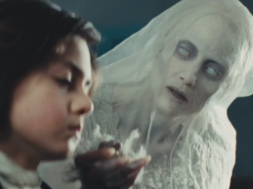
2006’s Stay Alive opts for a simple, yet effective premise that explains why it’s been endlessly imitated after the fact. A group of friends immerse themselves in a beta version of a possessed video game called “Stay Alive” that’s steeped in tragedy and equates in-game deaths to real-life casualties.
That’s really the long and short of the movie, which crafts a distinct identity for itself through timely references to G4techTV, prominent shots of Sega’s Dreamcast, and perplexing hints for Silent Hill.
Casting the Gamers of Stay Alive

This is all carried out by a cast of characters with names like Swink (Franke Muniz), October (Sophia Bush), Loomis (Milo Ventimiglia), and Phineus (Jimmi Simpson), who are decked out in 2000s gamer couture that makes Hackers’ costume design seem subtle in comparison. It almost seems like a ridiculous takedown of gaming that’s dripping in disdain. That being said, Stay Alive perpetually juxtaposes these moments of near-parody with true passion and adoration for the video game industry.
Bell and Peterman praised the film’s cast and the impressive talent that assembled for this horror film. They also spoke about how the film’s audition process turned into a who’s who of Hollywood. “Michelle Trachtenberg’s audition always stood out because she had this amazing scream,” admits Bell. “Channing Tatum was in there. Rami Malek was reading for Swink. Jonah Hill, too. It would have been so easy to just cut together a full scene with Jonah Hill into the movie, but they refused to let us because they were saying that nobody knows who this kid is. Then the next year, Superbad came out.”
It’s wild to consider a world in which 21 Jump Street could have been a Stay Alive reunion or that Swink Sylvania could have been portrayed by an Academy Award winner.
The Filmmakers’ Biggest Gaming Regret

There are elements of Stay Alive that are understandably shaggy two decades later. This is true of many horror films from the 2000s, even those that have nothing to do with gaming. What’s so interesting about Stay Alive is how the film’s premise and setup seem to predict the trend of streamer and “Let’s Play” culture way ahead of the curve. It’s a prescient window into where gaming culture would be a decade later.
“You’d be amazed at how we’d have to pitch people on the financial impact of the gaming industry at the time so that they could properly understand the size of this business. We were trying to explain how the movie should really just be like a trailer for the video game because the latter is going to do bigger business than the movie,” according to Peterman. “The biggest regret we have about the whole experience is that they didn’t release a game with the movie.”
Bell and Peterman approached the project with pure intentions and looking to do it the right way, but at every turn, there were pushes to trim the film’s gaming aspects, as if that wasn’t the whole point. At one point, an independent financier was on board to make Stay Alive for $2 million, with half the money going to the video game. As more producers came on board and the budget ballooned to $10 million, this crucial pillar fell to the wayside, particularly with a game that would have been distributed by Disney. “It would have been the most highly-marketed independent horror video game ever made,” muses Bell. Not only did this connective marketing not materialize, but the film’s gaming aspects were increasingly pared down. “We were fighting an uphill battle, and it was all a little too soon.”
To Stay Alive’s credit, the horror film attempted to create an unprecedented level of connectivity between movies and gaming that has yet to be matched. Stay Alive revolves around a fictional video game, but there were originally plans to produce copies of the film’s titular title. This ambitious synergy never came to pass, but the Stay Alive movie still includes Easter Eggs in the form of clues, codes, and cheats that could have been used in the tie-in title.
“We really wanted to create a situation where you could go to a movie and get a clue that could be applied to your video game experience, or vice versa,” reiterates Bell. It’s an enlightening look into something that ultimately wasn’t meant to be. It’s unlikely that the Stay Alive game would have become the next Resident Evil or Silent Hill, but it could have at least reached the same heights as more tertiary survival horror games like Dead Rising, Alone in the Dark, and D.
Capturing the Accuracy of the Video Game World

For authenticity, Cliff Bleszinski, a prolific game designer who was instrumental in Unreal Tournament’s development and is now at Epic Games, was brought on board as a “gaming consultant.” Bleszinski helped Bell and Peterman build a full video game bible document for Stay Alive, in which every movie element would correspond to some asset in the video game world. If nothing else, Bell and Peterman felt like they were on the right track and that Stay Alive had real legs as a video game due to Bleszinski really liking what they were doing.
The game’s development never reached the point that a playable build was made, but the finished bible would have made development possible. Bell and Peterman believed that a Stay Alive game might have become a reality if the film had been more of a success and spawned a full franchise, even though the game was meant to be a selling point to turn the film into a success.
The Stay Alive game never came to pass. However, Stay Alive’s DVD features an impressive degree of interactivity that dresses itself up as a video game. Not only does the DVD menu feature a bizarre character customization and builder, but there are also hidden menus in the DVD that reveal secret words that could then unlock additional content on Stay Alive’s official website.
“It’s got a whole secret if you solve it the right way,” boasts Bell. “It opens up a whole different menu with different things if you put together the right combination of elements.” It’s not the same thing as in-game bonus content, but it still teases the next-level marketing that was part of Stay Alive’s agenda.
The Unreleased Unrated Cut and Dashed Legacy Sequel Plans

MASHA KALININA.
© TOUCHSTONE PICTURES. ALL RIGHTS RESERVED.
Dashed plans for a tie-in title weren’t the only concession that had to be made with Stay Alive’s production. The horror film still accomplishes a lot in its finished theatrical edit, but it was conceived as a 120-page R-rated movie.
“It should have been a little shorter,” Bell concedes. “But when Disney came on board, they made it clear that it had to be PG-13 and 85 minutes long. That meant hacking up the movie and taking out the best parts and funniest lines. All the best action was too bloody, and the corresponding kills in the video game sequences were also cut.” Bell and Peterman admit that the 100-minute unrated cut that restores an erased storyline and character was a small joy, although they’re not optimistic that their preferred cut of the film will ever receive a Blu-Ray or 4K update.
On the topic of re-releases and revivals, Bell and Peterman had been reaching out every few years to see where Stay Alive’s rights were and what it would take to buy them back and save the property. These discussions intensified several years back after Spyglass Entertainment’s success with Scream (2022) led to the studio looking into relaunching other properties and making contact with Bell and Peterman.
“We had an idea, which is ‘Stay Alive today‘ put simply,” explains Bell. “Some of the old characters would be back, but there would also be new characters.”
The approach would have toed the line with what’s become more common in legacy sequels. Unfortunately, there was little desire from the studio to bring back characters, adhere to old lore, or even keep the film’s original title. “At that point, why are you even making it?” Bell asks incredulously. “We did want to make sure that the sequel still existed in the same world,” clarifies Peterman. “That’s something that appealed to us. Why would you not want to do more with those characters? I’m not talking about a straight rehash with all the same characters, or it’s now following their children or something.”

Elaborating on this hook, Bell adds, “Jimmi Simpson’s character died, but in a concept like the Metaverse, he would have been this ghost in the machine. He’s fucking trapped. At the point where they reach that next level in the story, they’d find that Jimmi Simpson’s character has been there the whole time, and he can’t leave. It’d give us more fun with Jimmi Simpson, and he’d be the mentor to the movie’s new characters for a little bit. Jimmi would be all over it, too.”
Beyond this legacy approach to a sequel’s potential casting, the most exciting aspect of a Stay Alive follow-up was playing around with how much technology has evolved in the past two decades. “There’s now streaming, VR, AR, the Metaverse. It’d look at an online game, but a practical game and how that game might be different because it’s not liked online,” confirms Bell.
As much as this sequel would incorporate horrors into a modern gaming context, it would also have been an opportunity to redeem the original Stay Alive’s unrealized potential. “We were pitching an entire universe. It was a whole franchise that would have started with a game and a movie, and not making the same mistake as last time,” Bell explains. “The game would have been developed side-by-side with the movie.” In the end, returning to a $10 million sequel that’s Stay Alive in title alone isn’t what Bell and Peterman were interested in.
It currently seems unlikely that a Stay Alive sequel, at least from Bell and Peterman, isn’t in the cards. However, this quirky oddity from the aughts has proven itself as an ahead-of-its-time title with true staying power. Stay Alive attempted to do something genuinely different and establish a new standard for video game horror. It may not have fully succeeded in this endeavor, but it remains a deeply entertaining standalone cult classic from the 2000s. And sweet Sebastian Bach is a fun, freaky time.
Matt Peterman shared an interesting anecdote in which Jimmi Simpson got some fake blood on his shirt after his character gets run over by a horse-drawn carriage and dies. Afterwards, Simpson immortalized Peterman’s shirt with his signature and the following wise words: In the end, may I be judged not on power, wealth, or love, but on pizzazz.
Two decades later, the same advice could just as easily apply to Stay Alive.