![‘Signalis’ and the Oppressive Mechanics of Survival Horror [Hands-On Preview/Interview]](https://scaryoverload.com/wp-content/uploads/2022/10/SIGNALIS-Penrose-1.png)
0
0

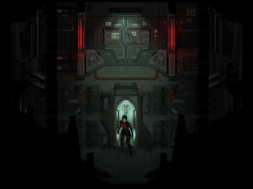





“I’m often a bit unsure if we really made a horror game at all,” Yuri Stern tells me.
Stern is one-half of the German studio rose-engine, and the co-designer on the upcoming dark sci-fi game, Signalis.
“I’m more concerned with atmosphere, symbolism, and character than with scaring the players,” Stern said via email. “For me, the horror in Signalis comes mostly from the oppressive systems and mechanics of old-school survival horror, which allows the story to be concerned with more personal themes.”
Signalis is set in another solar system, in the distant future, under the rule of an authoritarian government. Much of its industry, including an ongoing war effort, is conducted with cloned “Replika” units: artificial humans that are built from templates and designed to be replaceable.
You play as Elster, a Replika, who’s ended up stuck on an icy moon at the edge of the system after her starship crashed. The ship’s pilot’s gone missing, and Elster’s attempts to find her lead her to a mining colony that isn’t as abandoned as it initially looked.

There’s a lot more I’d like to say about Signalis‘s story, but even vague spoilers (up to and including the name of the mining colony) would rob it of some of its impact. As I’m writing this, I cleared my first run through the game over a week ago, and I haven’t really stopped thinking about it since. It’s a dense, sprawling narrative, which tries to build a world and society around you on the fly, and much of the story has been deliberately left up to the player’s interpretation.
“We tried to make a game that allows for different readings,” said Barbara Wittman, the other half of rose-engine, via email. “One theme of the game is the feeling of ‘otherness,’ and not fitting into an authoritarian society… it also combines themes that we were both really excited and passionate about, like dreams, androids, horror, and retro-tech sci-fi.”

Signalis has been built to feel a lot like a late-’90s survival horror game, with a sharply limited inventory and slightly awkward aiming controls. Like the first few Silent Hill games, Signalis‘s mining colony is littered with puzzles, the presence of which further unhooks you from any sense of reality.
You constantly have to juggle your weapons, ammunition, and health supplies against the tools, keys, and random debris that you need to advance further into the colony’s corridors. Individual fights aren’t hard to win, but they require you to use up resources that you might not be able to replace, and even then, enemies in Signalis don’t stay dead unless you incinerate their bodies with a flare.

Elster herself is a cloned soldier in a fascist society. Her limited inventory, according to an early file, was hard-coded into her personality as a method to preserve resources, because Replikas are typically more expendable than supplies.
The game is set in a procession of narrow hallways, mineshafts, and underground corridors. Everything around you is falling apart: physically, societally, organizationally. It’s not about jump scares; it’s about feeling like anything you can do is, and was always going to be, the wrong move. As Stern said, Signalis is essentially a game about oppression, both mechanically and narratively.
“Hopefully, we’ve managed to create a story that’s interesting on various levels,” Stern said. “I’m very curious how different people will interpret the game. While writing, I incorporated a lot of very personal elements into the game, so it’ll be interesting how it’s perceived by players of different backgrounds, but I’d rather not reveal too much.”
Signalis will be released for PC, PlayStation 4, Xbox, Xbox Game Pass, and Nintendo Switch on October 27.

The post ‘Signalis’ and the Oppressive Mechanics of Survival Horror [Hands-On Preview/Interview] appeared first on Bloody Disgusting!.
